Meet the founders · Davide
Davide Michieletto.
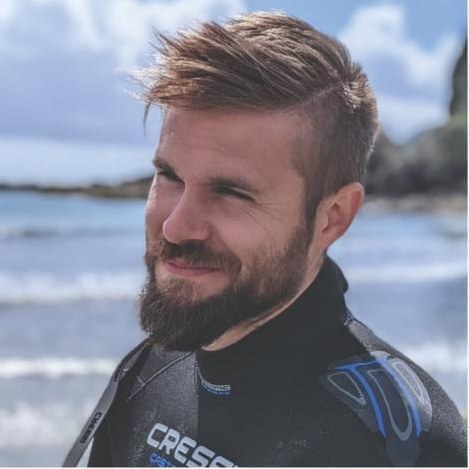
Co-founder, Critical Curiosity · Professor and Personal Chair in Biomaterials, University of Edinburgh
Davide is a physicist who has spent his career asking how tangled things behave, from rubber bands to DNA. He leads the Topologically Active Polymers Lab at the University of Edinburgh, where theory, simulation and experiment meet.
It started with “why?”
Davide grew up in Italy fascinated by physics and asking “why?” about everything. He wanted to understand nature, which he calls “the only indisputably real thing.”
When he was eight or nine, a primary-school teacher told his worried mother that he could do whatever he set his mind to and that his possibilities were unlimited. He believes that potential exists in everyone, but that it can matter enormously when someone you trust says it out loud. That conviction sits close to the heart of Critical Curiosity.
At sixteen he played as a defender for Treviso against Barcelona in a youth tournament. They lost 5–0, with Lionel Messi and Cesc Fàbregas on the other side. He was never the most naturally gifted player, but deliberate practice took him close to the top of his level, and he kept playing competitively until he left for the UK. He learned that hard work pays off, and that hard work is only part of the story.
Not everyone around him saw physics as a safe choice. That taught him early on not to make his ambitions depend on other people’s approval.
A can of rubber bands.
He studied theoretical physics at the University of Padova. At first he struggled, and scraping a pass felt like an achievement until he saw classmates doing far better. If they could do it, so could he. He changed the way he studied and graduated with 110/110 cum laude.
He was already drawn to the meeting points of physics and biology, order and disorder, shaped by books such as Erwin Schrödinger’s What Is Life? and Fritjof Capra’s The Tao of Physics. During his PhD at the University of Warwick, his supervisor Matthew Turner handed him a can of tangled rubber bands and said: “Try to pull one out.” That simple experiment gave his instincts a physical object, polymers, and set the direction of his career.
By connecting the physics of glasses with ring polymers, he discovered in simulations a “topological glass.” The resulting paper with Matthew Turner, “A topologically driven glass in ring polymers” (PNAS, 2016), remains the work he is most proud of.
Becoming a beginner again.
After his PhD he moved to Edinburgh to join Davide Marenduzzo’s group. A few years later he stepped out of his comfort zone to work with experimental collaborators led by Nick Gilbert at the Institute of Genetics and Cancer. Seeing human cells under a microscope for the first time, he found “a stage full of fluorescent prima donnas,” and realised he had to appreciate the experiments before he could model cells well.
Being a beginner again was refreshing. His training as a theorist helped him notice physical properties that biologists might treat as incidental, such as how viscous a DNA solution is. He began cutting DNA with restriction enzymes and watching the viscosity change, combining theory, simulation and experiment. The work became “Topological digestion drives time-varying rheology of entangled DNA fluids” (Nature Communications, 2022).
Along the way he found that, in 1970, Hamilton Smith and Kent Wilcox had used the same kind of viscosity change in work that led to the first Type II restriction enzyme, and to a share of the 1978 Nobel Prize. Half a century later, their measurements helped validate a modern theory of DNA fluids.
Finding the bigger question.
Between 2016 and 2018 he wrote fellowship application after fellowship application, and every one was rejected. The turning point came when a mentor urged him to step back and ask what the bigger picture was. He saw that statistical physics, polymers, DNA, simulations and experiments all revolved around one idea: topology. Inspired by the way proteins reshape DNA inside cells, that idea became “topologically active polymers” and the foundation of his lab. In his words, “Big questions must be earned through the path that brings you to them.”
In 2021 he became a Royal Society University Research Fellow and won a European Research Council Starting Grant. His group grew from one person to fourteen, through the pandemic. Then in 2023 he burned out. It taught him that effort without judgement has limits, and that a group leader’s job is to create the best possible conditions for the people in the team to grow.
In 2025 he was appointed Professor and Personal Chair in Biomaterials at the University of Edinburgh. He describes himself as ambitious, hard-working and very, very lucky, and credits the unwavering support of his wife and their three children.
Why Critical Curiosity.
As a scientist and a dad of three, Davide believes the scientific method is a pillar of how good students think: ask a question, make a guess, test it against the world and follow evidence wherever it leads. His motto is that “every piece of data is telling you something about nature, or about yourself”.
Critical Curiosity Labs is his answer to turning AI into a beneficial tool for students and humanity. He writes about rejection, luck, doubt, mentorship and wrong turns, the parts of academic life that rarely appear in papers or CVs, on Substack.
Keep reading.
Davide shares more of his journey, and what it has taught him about science, failure and growth, on Substack.